Federal Education Funding
Current federal primary and secondary education funding represents approximately 2.4% of total collected federal income taxes. That amount is distributed via a variety of federal agencies and departments to fund specific programs (head start, school lunches, etc.) in schools across the country. We propose consolidating these programs into a single funding source, and formally tying the funding rate to the total collected income tax revenue, then distributing it to schools and allowing them to choose how to spend it.
Goals
Local Control
Curriculum should be decided by individual teachers, schools, and districts, rather than dictated from above. One size fits all curriculum design is not appropriate for a country as diverse as ours.
Additionally, local control of curriculum allows schools to experiment and focus on whatever they think will benefit their students the most, whether that’s a focus on “reading, writing, and ‘rithmetic,” physical education and health, music and the arts, shop, trades, and practical arts, whatever.
Local control of funding goes beyond curriculum. Some schools may find that maximizing student success requires the school to provide comprehensive after-school care, or multiple school meals per day, while other schools may choose to focus on organizing community support with job shadowing and volunteer programs, and still other schools may choose to spend more on teacher salaries and/or continuing education for faculty.
In the end, the people best suited to understand what a particular school or district needs to maximize student success are the teachers and administrators of that school or district.
Accountability
We should reward success where we find it and encourage less-successful schools to improve or close. School funding should be tied, at least in part, to student success. We should provide additional funding to schools and districts which have proven they can spend it effectively and withhold funds from schools and districts which have proven they cannot.
Educated Populace
As a counterpoint and corollary to accountability, there must be some provision for funding new schools that do not have an established track record. Funding for new schools ensures that if a failing school closes, the students formerly served by that school are no left out in the cold. Instead, we must provide an opportunity for a new school to arise to fill the gap. The easier it is to start new schools, the easier it will be to replace failing schools. In addition to funding for new schools, there must be some floor below which funding cannot drop, so that even a school on the brink of failure and subsequent closure can still provide at least some education to its students.
The System
An explicit percentage of collected income tax (percentage X) will be allocated to school funding. From this revenue, we will create two funds, Fund A and Fund B. Some of the revenue will go into Fund A (percentage Y) and the remainder into Fund B.
Fund A is the accountability fund. Every taxpayer contribution to Fund A will be tracked and allocated to the schools and districts in which that taxpayer was educated. If you spent your childhood in one city and attended primary and secondary schools in the same district, all the money you contributed toward Fund A will go to that district. If you moved around and were educated in schools in multiple districts, your contribution to Fund A will be divided among them on a pro-rated basis. If you were educated outside the United States, or a school you attended no longer exists or is not eligible to receive funds under this system, the Fund A money that would be allocated to that school is instead transferred to Fund B.
Fund B is the educated populace fund. Fund B is distributed evenly to schools around the country on a per-student basis.
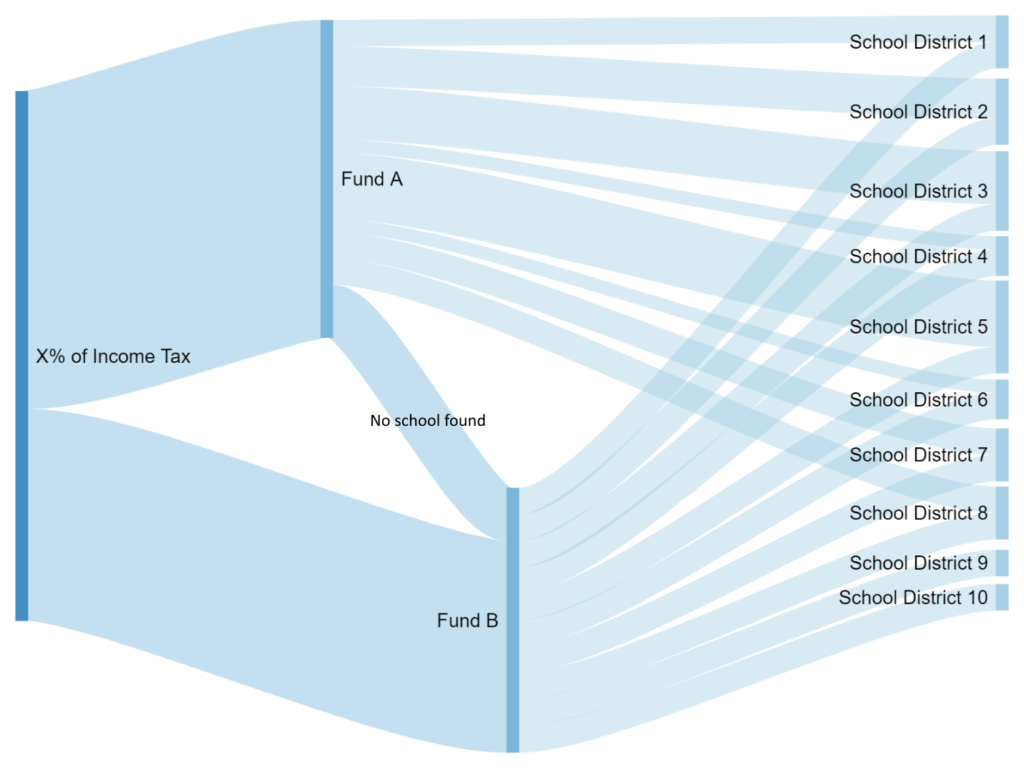
Eligible schools and districts will receive their allocated money with no strings or restrictions attached. Districts and schools can allocate funds from this system to various schools, grade levels, and programs as they see fit, to maximize student success.
To be eligible, a school district must offer education to any person of school age in the geographic region they serve. This includes providing individual or special education resources as needed, and transportation to and from schools where applicable. Schools that restrict enrollment on any basis other than geographical, including private tuition requirements, religious requirements, or academic requirements are ineligible to receive funds under this system, unless they are part of a district which includes an alternative school for students unable to attend the restricted school.
Adjustments
Adjusting percentage X, the fraction of taxable income devoted to education funding, increases or decreases the value we place on education as a predictor for future success.
Adjusting percentage Y, the initial split between Fund A and Fund B, increases or decreases the system’s focus on accountability. Putting more money into Fund A increases the difference in funding between schools and districts with a record of success and those without. Putting less money into Fund A and more into Fund B makes it easier to start new schools, that start without any track record at all, and raises the minimum funding per student that even a failing school will receive.